
Agriculture, Horticulture & Rural Development
Farming still supports most of the households we work with — and it's also where climate risk, soil health, and income insecurity hit first. ECCON works alongside farmers to make agriculture more resilient, more profitable, and less dependent on chemical inputs.
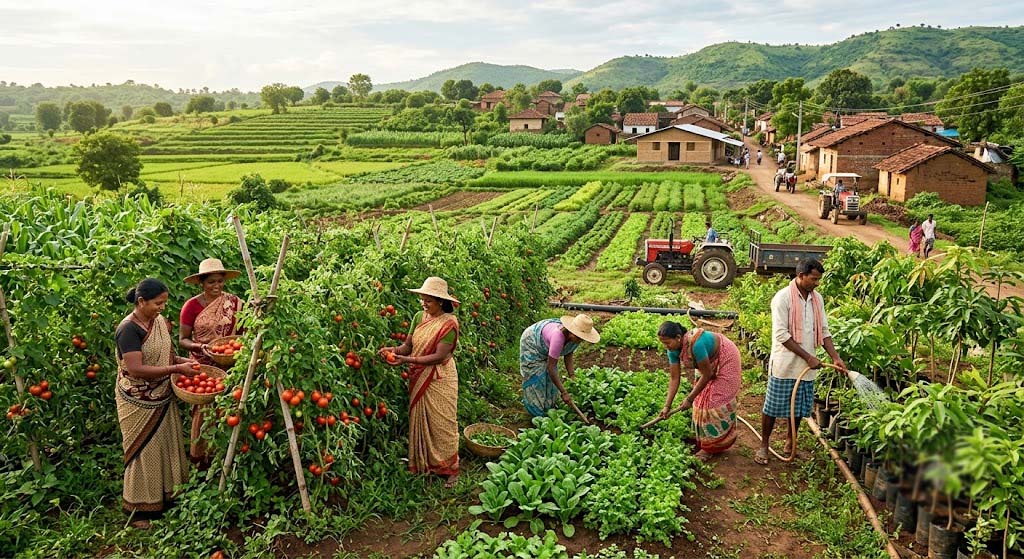
For most rural families, farming isn't one income source among several — it's the whole economy. That makes every shock to it, from a failed monsoon to a collapsing input cost, a shock to the entire household. Yet the same land, farmed differently, can be the foundation of real, lasting income security.
ECCON's agriculture work moves from the soil upward — reducing dependence on costly chemical inputs, preparing farms for a shifting climate, and helping farmers capture more value from what they grow instead of selling it at the farm gate for the lowest price.
Organic and Natural Farming
Growing more by putting less into the soil
Years of chemical-intensive farming have left many soils tired and farmers dependent on rising input costs. We train farmers in organic and natural farming methods that rebuild soil health, cut input expenses, and open access to the premium markets that reward chemical-free produce.
- Training in composting and natural input preparation
- Bio-pesticide and biofertilizer adoption support
- Support for organic certification where viable
- Soil health testing and restoration planning
Climate-Smart Agriculture
Farming that plans for an uncertain monsoon
Rainfall and temperature patterns no longer follow the calendars farmers grew up with. We help farmers adopt drought-tolerant varieties, efficient irrigation, and crop diversification strategies that reduce the risk of a single bad season wiping out an entire year's income.
- Drought-tolerant and climate-resilient seed varieties
- Drip and efficient irrigation adoption support
- Crop diversification and mixed cropping guidance
- Weather-based advisories for sowing and harvest timing
Medicinal and Aromatic Plant Cultivation
Higher-value crops for smaller landholdings
Medicinal and aromatic plants often earn more per acre than traditional staple crops, making them well suited to farmers with limited land. We support cultivation of high-demand species, connect growers to processors and buyers, and provide the training needed to grow these crops correctly.
- Cultivation training for high-demand medicinal species
- Aromatic and essential-oil crop cultivation support
- Linkages with processors and pharmaceutical buyers
- Guidance on post-harvest handling and drying
Agri-Business and Value Addition
Earning more from the same harvest
Raw produce sold at the farm gate captures only a fraction of its final market value. We help farmers set up basic processing — grading, packaging, and simple value-addition units — so a portion of that downstream value stays with the people who grew it.
- Basic processing and value-addition unit setup
- Grading, packaging, and quality standardisation support
- Guidance on agri-enterprise business planning
- Market and pricing linkages for processed products
Farmer Capacity Building
Building the know-how behind every good harvest
New techniques only take root when farmers have the confidence and knowledge to apply them correctly. We run field schools, demonstration plots, and hands-on training that build practical, lasting agricultural skills — not just one-time advice that fades after the season ends.
- Farmer field schools and demonstration plots
- Training on modern agronomy and best practices
- Exposure visits to model farms and research centres
- Peer learning groups among local farmers
Rural Livelihood Enhancement
Diversifying income beyond a single crop
A household tied to one crop is exposed to every price swing and bad season. We support allied livelihoods — livestock rearing, poultry, beekeeping, and off-season activities — that give rural families a second and third income stream alongside their main farming work.
- Livestock and poultry rearing support
- Beekeeping and allied income-generation training
- Off-season and non-farm income diversification
- Support forming farmer self-help and savings groups
Why our approach works
These six focus areas aren't run as separate programs — they're designed to reinforce one another on the ground, guided by a few principles that shape every agriculture project we take on.
Community-centered
Every practice is introduced with the farmers who'll depend on its outcome — not prescribed from outside the field.
Science-based
Soil tests and weather data — not assumptions — guide which crops, inputs, and timings we recommend.
Locally rooted, widely relevant
Solutions are matched to each region's soil and climate, then refined into models other farming clusters can adopt.
Built for the long term
We stay engaged across multiple seasons, because soil health and farmer confidence both take years to rebuild.