
Environment & Climate Action
From the soil beneath our feet to the air we breathe, ECCON works where ecological health and community wellbeing meet — restoring landscapes, cutting pollution, and preparing communities for a changing climate.
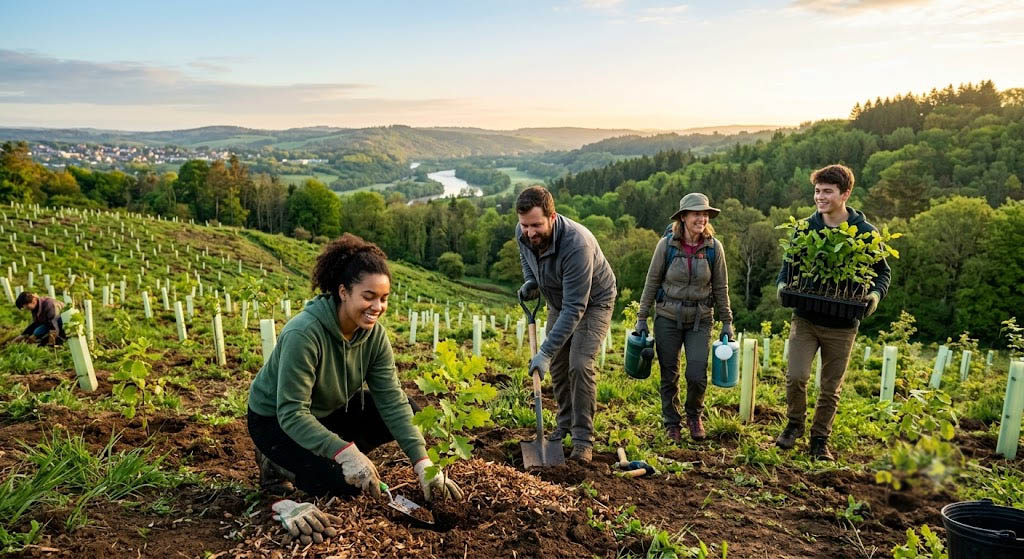
Environmental degradation and climate change hit the poorest communities first and hardest — through failed harvests, drying wells, and vanishing forests they once depended on. ECCON's environmental work is built to respond on both fronts at once: protecting the ecosystems that sustain rural life, and equipping communities with the tools to adapt to a climate already in flux.
We work across six interconnected areas, each reinforcing the others — because a watershed restored, a wetland protected, and a village trained in climate-smart farming are pieces of the same picture.
Biodiversity Conservation
Protecting the ecosystems rural life depends on
We work with communities living closest to forests, wetlands, and grasslands to protect native species and restore the habitats they depend on — recognising that conservation only lasts when the people around it have a stake in its success.
- Restoration of native flora and degraded habitats
- Community-led protection of forests and wetlands
- Wildlife corridor development to reduce fragmentation
- Awareness building on human-wildlife coexistence
Afforestation and Watershed Development
Rebuilding green cover, recharging water sources
Tree cover and water availability rise and fall together. Our afforestation drives are paired with watershed structures — check dams, trenches, and harvesting pits — so that new plantations take root in soil that can actually hold water through the dry months.
- Community and school-led tree plantation drives
- Check dams and water harvesting structures
- Soil and moisture conservation on degraded land
- Native species selection for lasting ecological fit
Climate Adaptation and Mitigation
Building resilience for a changing climate
Erratic rainfall and rising temperatures are already reshaping how rural communities farm and live. We help households diversify their livelihoods and adopt climate-resilient practices, while promoting the low-carbon choices that reduce their own contribution to the problem.
- Climate-resilient agriculture and livelihood diversification
- Early warning and disaster risk reduction support
- Promotion of renewable energy and low-carbon practices
- Training on climate adaptation strategies
Waste Management and Circular Economy
Turning waste into a resource, not a burden
Most rural and peri-urban waste problems are solvable with the right systems, not just goodwill. We build segregation habits at the household level and connect communities to composting and recycling models that turn what used to be waste into income and usable material.
- Household and community waste segregation programs
- Composting and organic waste management units
- Support for local recycling and upcycling enterprises
- Campaigns to cut single-use plastic dependence
Pollution Control and Environmental Monitoring
Safeguarding the air, water, and soil people rely on
You can't manage what you don't measure. We track water and air quality in our project areas, work with local bodies to act on pollution sources, and give communities a simple way to flag problems before they become health crises.
- Water and air quality monitoring in project areas
- Community reporting mechanisms for pollution sources
- Collaboration with local bodies on control measures
- Promotion of eco-friendly alternatives to polluting practices
Environmental Education and Awareness
Nurturing environmental stewardship early
Every intervention above lasts longer when it's understood, not just delivered. We run environmental education in schools, form nature clubs, and mark environmental observances with communities so that conservation becomes a shared habit, not a one-off project.
- Environmental education modules in schools and colleges
- Awareness campaigns on conservation and sustainability
- Nature clubs and eco-volunteer programs
- Community celebration of environmental observance days
Why our approach works
These six focus areas aren't run as separate programs — they're designed to reinforce one another on the ground, guided by a few principles that shape every project we take on.
Community-centered
Every intervention is designed and led with the people who live with its results — not delivered to them from outside.
Science-based
Monitoring data — not assumptions — guides where and how we intervene, and tells us when to adjust course.
Locally rooted, widely relevant
Solutions are built for the specific landscape they serve, then refined into models other regions can adapt.
Built for the long term
We stay engaged well past a project's launch, because ecosystems and habits both take years to recover.